The Green Bay Packers’ 34–26 loss to the Denver Broncos on Sunday did more than snap a four-game winning streak. The damage came in the form of injuries, and there were plenty of them.
Green Bay lost several players during the game, including some of the most important pieces on the roster. As the Packers left the field, the health concerns overshadowed the final score.
Here’s a breakdown of every notable injury from Week 15.
Micah Parsons
𝗕𝗥𝗘𝗔𝗞𝗜𝗡𝗚: Packers’ LB Micah Parsons is currently down and holding at his knee.
It appeared to be a non-contact left knee injury.
🙏🙏🙏pic.twitter.com/93b44oAfyK — Dov Kleiman (@NFL_DovKleiman) December 14, 2025
This one was devastating.
The Packers’ star edge rusher suffered a knee injury late in the third quarter, and NFL Network reported there is concern the injury could be a torn ACL.
Parsons went down on a non-contact play as he was closing in on Broncos quarterback Bo Nix on a first-down snap, with Green Bay holding a 23–21 lead. Trainers immediately attended to him, and Parsons could be heard saying, “I’m out.”
If the diagnosis is confirmed as a torn ACL, Parsons’ season would be over. It would be a cruel ending to a dominant first year in Green Bay for one of the NFL’s most disruptive defenders. Acquired in a blockbuster trade before the season, the multiple-time All-Pro exceeded expectations and transformed the Packers’ defense.
Now, Green Bay may have to move forward without its biggest game-changer.
Christian Watson
Christian Watson #packers
Elbow hits the ground which exerts significant force into his shoulder. The second view here you can see the humerus shifting superior within the socket.
Hard to know from video exactly what tissues are involved but I’d be concerns for the rotator… pic.twitter.com/YO5rYV9DwA — Tom Christ, PT, DPT, OCS, FAAOMPT (@FantasyInjuryT) December 14, 2025
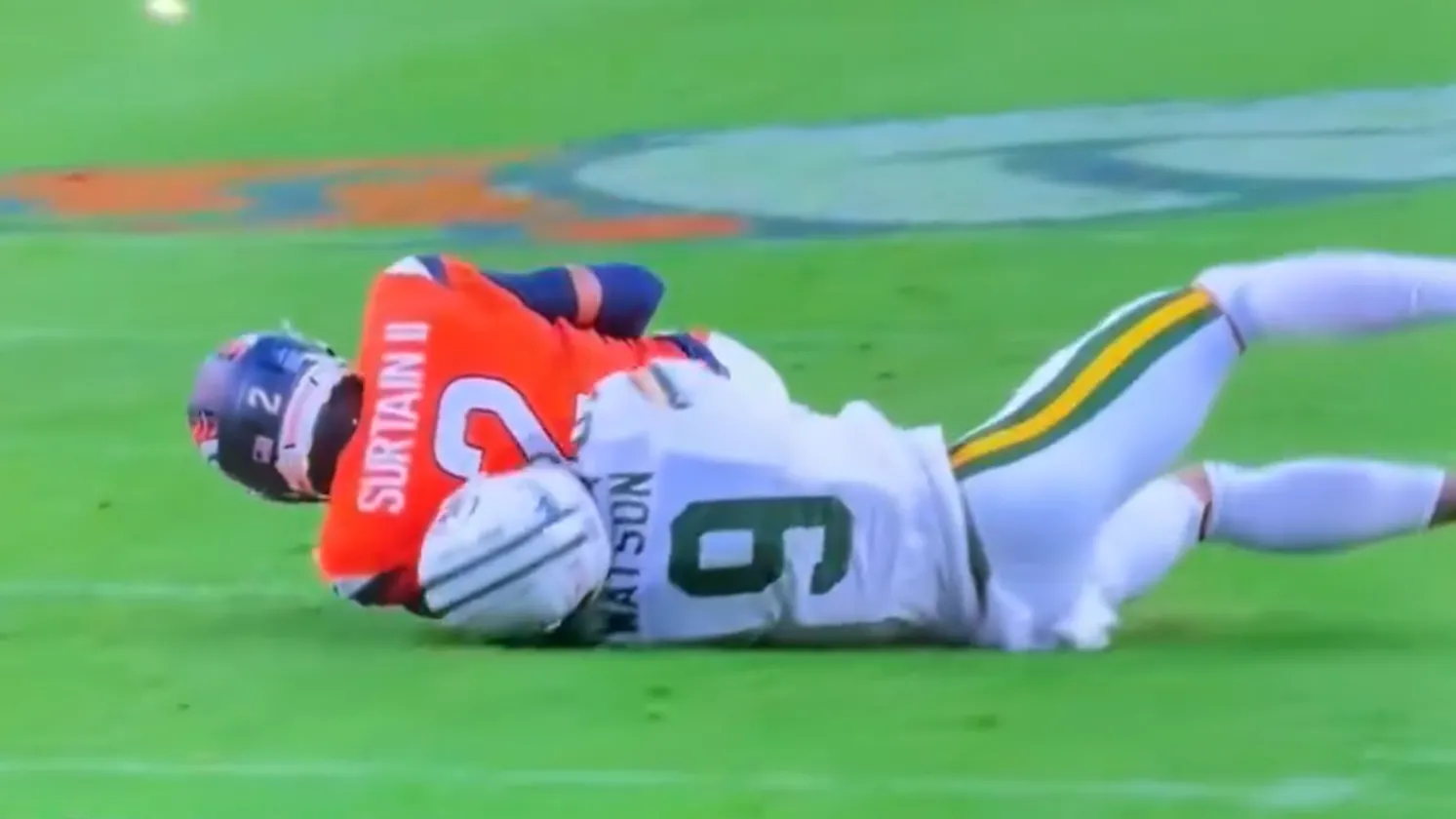
Before Parsons went down, the Packers lost Christian Watson in the third quarter.
Watson, Green Bay’s most explosive offensive weapon, exited with a chest injury after crashing to the turf while attempting to make a deep catch that was intercepted by Patrick Surtain. Since returning in late October from a torn ACL suffered at the end of the 2024 season, Watson had firmly re-established himself as the team’s top offensive threat.
He was taken to the hospital for evaluation but was later released and flew home with the team.
Zach Tom
Offensive lineman Zach Tom left the game in the first half with a right knee injury.
Tom expressed confidence that the injury was not long term, but his absence would be significant for an offensive line already dealing with the season-ending broken ankle suffered by Pro Bowl center Elgton Jenkins. Tom signed a major contract extension this summer and is a cornerstone of the unit.
Evan Williams
Second-year safety Evan Williams exited in the second half with a knee injury.
While the injury does not appear to be long term, any loss in the secondary could hurt the Packers as they prepare to face Chicago Bears quarterback Caleb Williams and Baltimore Ravens star Lamar Jackson over the next two weeks.
Josh Whyle
The first injury of the day belonged to tight end Josh Whyle.
Green Bay’s third-string tight end suffered a concussion in the first quarter. Whyle had been active after Tucker Kraft was lost for the season with a torn ACL in early November. A third-year player, Whyle began the season on the practice squad before being elevated.
Jayden Reed
Jayden Reed may not appear on the injury report, but his status is worth monitoring.
The third-year receiver was slow to get up on the Packers’ final drive and left the game with 56 seconds remaining while Green Bay trailed 34–26. The specific issue was unclear, though it appeared to be a lower-body injury, and he did not return.
Reed had just come back last week after missing three months with a broken collarbone and a foot injury.
Jets Limit Steelers Fans to 500 Tickets, Forcing Many to Pay Double on Secondary Market

Pittsburgh, PA – September 4, 2025
The buildup to Sunday’s matchup between the New York Jets and Pittsburgh Steelers has already sparked controversy — and it’s not about anything happening on the field. It’s about who gets to be in the seats.
According to team officials, the Jets allocated just 500 tickets to visiting Steelers fans, a move that has left Pittsburgh’s notoriously loyal following scrambling for access. For many, the only option has been to hit the secondary market, where prices have reportedly soared to more than
double face value.
That scarcity has created another wrinkle. Brokers on resale platforms and in-person markets are selling seats not only at inflated prices but often in Jets-designated sections
, effectively scattering Steelers fans around the stadium and limiting their ability to cheer as a unified group.
For a franchise like Pittsburgh, whose fan base is known for traveling in massive numbers and often overtaking opposing venues, the move feels like an intentional attempt to blunt their impact. Steelers Nation has earned a reputation for turning road games into quasi-home atmospheres, something the Jets clearly appear keen to avoid.

Fan reaction has been swift. Social media threads filled with complaints from Steelers supporters describe frustration at paying hundreds over market price for single seats, often tucked deep in Jets-heavy sections. Others lament the lack of family packages, with many parents unable to bring kids due to cost.
The Jets, meanwhile, have defended the limited allocation, citing both stadium policies and a desire to prioritize their own season-ticket base. The organization insists the policy is consistent with how they’ve handled other high-demand games in recent years.
Still, the optics are hard to ignore. What should be an electric early-season clash now carries a subplot about fairness, fan access, and the ongoing tension between ticket policies and league-wide fan culture.
When the Jets and Steelers kick off, the stadium will be packed. But whether the sound inside reflects a balanced NFL crowd or a heavily tilted home advantage is a question already shaping this rivalry before the first snap.